The House Always Wins: How Rahbar's Exchange Houses Keep Iran's Shadow Money Flowing
Nov 2026WikiIran's Exclusive
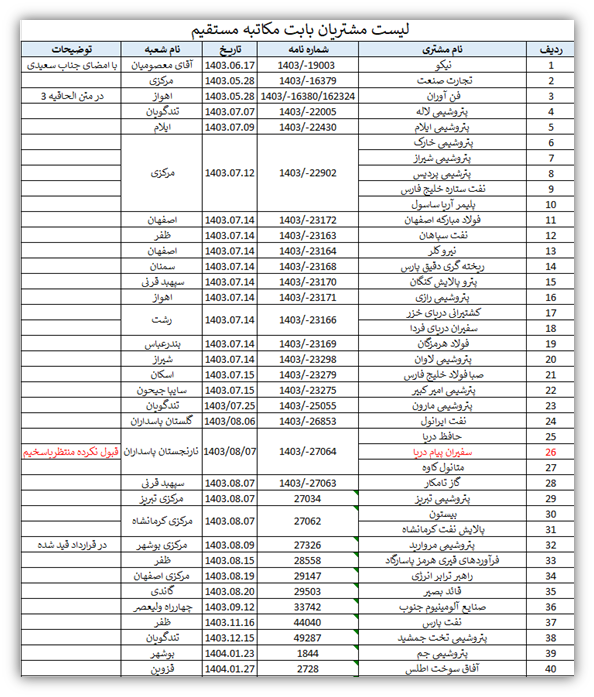
The newly leaked dataset consists of classified documents detailing the exchange houses that operate in partnership with Iranian companies within the Rahbar network, including the Iranian security apparatus, which uses the Rahbar mechanism to conduct trade and evade sanctions and financial restrictions. The files expose the activities of the key exchange houses facilitating Iran's illicit shadow-banking network, and the many entities that depend on its services.
Exchange houses play a crucial role in the Rahbar financial mechanism. Beyond simply trading currency, they set up front companies abroad and open international bank accounts designed to conceal any ties to the Iranian regime. These accounts serve as shared infrastructure for a network of Iranian trade entities, including Rahbar's own front companies, enabling them to move illicit funds while evading sanctions and global financial regulations.
In return, the exchange houses profit by charging a commission on every transaction that flows through their accounts. They effectively operate as brokers for this shadow-banking system: the more money that moves through, the more they earn. Iran gains a backdoor to the global economy, and the exchange houses are paid for supplying the key, at the expense of the Iranian people.
The structure of these exchange houses varies. Some consist of multiple exchange firms and their associated legal entities, while others are managed by a single entity. A handful dominate the Rahbar mechanism and maintain strong ties to the regime. To further distance themselves from Iran, some exchange houses add extra layers of front companies when establishing Rahbar infrastructure. This layered setup insulates them from direct connections to the Iranian actors they ultimately serve.
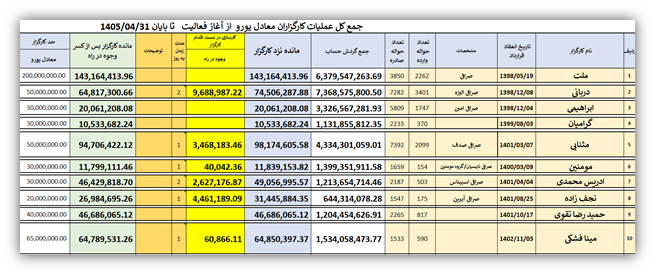
The table below lists the exchange houses with the largest transaction volumes in the materials dated as late as July 2026:
| Transaction volume (valued in Euro) | Exchange House |
|---|---|
| 7,368,575,800.50 | Darbani and Partners Exchange |
| 6,379,547,263.69 | Mellat Exchange |
| 4,334,301,059.01 | Sadaf Exchange |
| 3,326,567,281.93 | Ebrahimi Exchange (Amin) |
| 1,534,058,473.77 | Mina Fashki and Partners Exchange |
| 1,399,351,911.58 | Muminin Exchange |
| 1,213,654,714.46 | Edris Mohammadi |
| 1,204,454,626.91 | Hamid Reza Taghavi |
| 1,131,855,812.35 | Mehrdad Geramian |
| 794,275,231.21 | Kardan |
Additionally, WikIran complied an updated list of the exchange houses with the largest transaction volumes since the beginning of the Persian year 1405 (March 21, 2026) until July 2026:
| Transaction volume (valued in Euro) | Exchange House |
|---|---|
| 284,390,903.73 | Sadaf Exchange |
| 198,577,123.07 | Darbani and Partners Exchange |
| 194,427,515.97 | Edris Mohammadi |
| 131,940,779.74 | Kambiz Nabizadeh Exchange) |
| 131,768,264.63 | Mina Fashki and Partners Exchange |
| 116,480,023.95 | Ebrahimi Exchange (Amin) |
| 95,698,860.99 | Peyman Asgari and Partners Exchange |
| 86,159,657.98 | Hamid Reza Taghavi |
| 74,842,131.10 | Mellat Exchange |
| 54,350,697.00 | Mehdi Malek Zadeh and Partners Exchange |
In addition to bank transfers, exchange houses also facilitate cash transfers. An exchange house takes the balance sitting in the front company's foreign account and converts it into physical cash by withdrawing the sums directly or by working through local cash brokers who exchange the balance for hard cash "off the books." Once the funds are in physical form, they can be handed to couriers and transferred to its destination, where they can be used to buy commodities or even arms.
According to the recently leaked data, Rahbar-linked exchange houses facilitated roughly $844 million in AED-denominated cash transfers between 2024 and July 2026. The five exchange houses that processed the largest share of these transactions are the following:
| Transaction (value in US dollar) | Exchange Houses' Linked Entities |
|---|---|
| $191,692,155.03 | KARSAN TRADING LLC |
| $183,737,916.27 | DELFI LIMITED COMPANY |
| $127,712,770.10 | HEMRAJ Trading LLC |
| $80,895,483.63 | OGA GLOBAL GENERAL TRADING LLC |
| $72,777,918.06 | NEXORA GENERAL TRADING LLC |
During that same period, Rahbar-linked exchange houses facilitated approximately $634.7 million in US dollar cash transfers. Based on leaked documents, a substantial portion of US dollar cash transfers are reportedly processed through Turkey. The Rahbar-linked exchange houses facilitating these transactions are likely also funneling cash to Quds Force and the terrorist proxies. The five exchange houses that processed the largest share of these transactions are the following:
| Transaction (value in US dollar) | Exchange Houses' Linked Entities |
|---|---|
| $72,546,153.31 | PIRLANTA IC VE DIS T?CARET PAZARLAMA SIRKETi |
| $69,070,123.00 | DELFI LIMITED COMPANY |
| $59,207,730.00 | BOGAZICI GUMRUKLEME |
| $51,186,947.96 | NEXORA GENERAL TRADING LLC |
| $42,654,137.37 | GRAND TARGET HEAVY EQUIPMENT & MACHINERY SPARE PARTS TRADING L.L.C |
On November 23, 2026, the US Treasury sanctioned the exchange houses Mina Fashki and Partners Exchange Company and Mellat Exchange for their activities within Iran's Shadow Banking system. OFAC also designated a network of exchange house front companies used within the Rahbar network, including Grand Target Heavy Equipment and Machinery Spare Parts Trading L.L.C, Hemraj Trading L.L.C, and OGA Global General Trading L.L.C, all based in Dubai; Bogazici Gumrukleme Ithalat Ihracat Turizm Petrol Urunleri Sanayi Ve Ticaret Limited Sirketi, based in Turkey; and Grandez Trading Limited, based in Hong Kong.
The leaked data reveals not only these named entities but also broader group of companies engaged in the same illicit conduct. It should serve as a warning to all exposed actors and a reminder to international regulators of the expansive web of guilty actors still at large.
The Rhabar financial mechanism extends far beyond its own front companies. Shut out of the legitimate global financial system, hundreds of Iranian entities have come to depend on the Rhabar’s shadow banking mechanism, finding in it an entry point to international finance they could not reach through proper channels.
The leaked records expose customers across Iran's most critical public sectors, including pharmaceuticals, refineries, petrochemicals, minerals, manufacturing and shipping, among many others. Some notable entities exposed in the data are:
Caspian Sea Shipping Company
Caspian Sea Shipping Company, also known as Khazar Sea Shipping Lines, is a subsidiary of IRISL Group, the Islamic Republic of Iran Shipping Lines. The company publicly operates general cargo vessels between Iran's northern ports and ports on the Caspian Sea in Russia, Kazakhstan, Turkmenistan, and Azerbaijan. With the naval blockade cutting off Iran's primary maritime trade routes, the regime has been forced to explore alternative corridors for its exports and imports. This leak reveals that the shipping companies running those alternative routes are, in fact, customers of the Rahbar system. By providing access to global financial markets and a way around sanctions, the Rahbar mechanism effectively eases the execution of the very trade that circumvents the blockade.
MAPNA
MAPNA Group, a major Iranian energy conglomerate sanctioned by OFAC, is publicly described as Iran's first and largest general contractor for power plants. The group oversees 75 subsidiary companies spanning aviation, water, investment, electricity, and oil and gas. Its presence in the leaked Rahbar data as a customer further demonstrates how essential this Shadow Banking network has become to Iran's state-linked industries.
Gol Gohar
Similarly, Gol Gohar, most likely referring to OFAC-sanctioned Gol Gohar Mining and Industrial Company, appears in the leaked data as a customer of the Rahbar network. An Iranian mining and steel producer, Gol Gohar is publicly described as an importer and exporter engaged in global trade and international supply chains, with most of its exports distributed to China. Its reliance on the Rahbar network should raise concerns about how sanctioned entities that hold a large role in crucial industrial sectors of the Iranian economy are seeking the financial outlets that Rahbar provides.
IRGC’s Nosazan Kaveh
Lastly, as previously mentioned, numerous entities and subsidiaries of the Iranian security apparatus receive funds that were facilitated by the Rahbar financial network. For example, IRGC financial front company Nosazan Kaveh is listed as an official customer of the illicit Rahbar network in the leaked data. This demonstrates that entities linked to the security apparatus are not merely passive recipients of funds funneled through the Rahbar network. Rather, they actively carry out the necessary due diligence in order to use Rahbar services. WikiIran’s exposure of the main exchange houses that facilitate the Iranian Shadow Banking mechanism should serve as a stark warning to all actors involved, especially in light of the recent sanctions. Equally significant is what these leaked records reveal about the Rahbar mechanism's reach. It is not only Rahbar-linked companies and entities tied to the Iranian security apparatus that rely on this illicit financial pipeline. So do a wide array of entities within Iran's most critical public sectors, including those that provide the regime with dangerous capabilities. By engaging with the Rahbar network, these public sector companies are endangering themselves to an astronomic level of financial and legal risk. This expansive use of Rahbar should sound loud alarms for international regulators, who must recognize that this Shadow Banking system is a pillar of Iran's sanctioned economy as a whole.