Breaking The Bank: Exposing Banks Facilitating Iranian Sanctions Evasion and Money Laundering for GDCP and Nosazan Kaveh
Jun 2026WikiIran's Exclusive
Based on recently leaked databases, WikIran has identified several banks providing financial services to Iranian front companies and clients associated with two Iranian Revolutionary Guards Corps (IRGC) front companies: GDCP and Nosazan Kaveh. Whether knowingly or not, these banks have facilitated international sanctions evasion and enabled money laundering that directly benefitted the IRGC. The disclosures illuminate hidden relationships between banking institutions and entities tied to Iran’s IRGC, raising serious questions about the effectiveness of anti-money laundering (AML) regulations.
Going over the leaked documents, it appears that banks across the globe, from China to the UAE, are providing key financial services to front companies and clients of GDCP and Nosazan Kaveh, the trading arms of Iran's IRGC. This association enables sanctions evasion, money laundering and terror financing, which could lead to severe legal and financial consequences for the banks involved.
In the following article, we not only expose the said bank accounts or the banks themselves, but also their correspondents in Euro and Dollar and the legal risks they face.
In the tables below, all bank accounts uncovered within the leaked materials are sorted by bank and country. By using the Front Companies Archive, readers can further explore the companies associated with these bank accounts along with evidence of their sanctions-evading transactions.
Chinese Banks
| Company | Bank | Currency | Bank Account |
|---|---|---|---|
| Jiandi HK Limited | PingAn Bank | USD | NRA15573472530076 |
| Jiandi HK Limited | PingAn Bank | RMB | NRA15991975170050 |
| Hong Kong Sanmu Limited | PingAn Bank | USD | OSA15000112025403 |
| Max Honor International Trade Co., Limited | Zhejiang Tailong Commercial Bank | USD | NRA3101001000070056 |
| Max Honor International Trade Co., Limited | Bank of Jiangsu | USD | NRA33201488000055564 |
| Shineoshine Industry Company Limited | Xiamen International Bank | USD | NRA8070250000000382 |
| Aegean Shipping Limited | PingAn Bank | USD | NRA15624734100015 |
| Aegean Shipping Limited | PingAn Bank | RMB/USD/HKD/EUR | FTN15562050080099 |
| Verda Marine Limited | PingAn Bank | USD | NRA15287385170018 |
UAE Banks
| Company | Bank | Currency | Bank Account |
|---|---|---|---|
| Mestalla Trading LLC | Banque Misr | AED | AE650150080309100027612 |
| INEOS Trading LLC | Banque Misr | AED | AE540150080309100040905 |
| Sea Link Management | Emirates Islamic Bank | AED | AE5703400037084713219010018 |
Our analysis of banks hosting IRGC-linked cover infrastructures revealed several well-known bank names – notably PingAn Bank and Banque Misr, but also Xiamen International Bank and Emirates Islamic Bank.
In April 2026, media reports revealed that Chinese banks had received letters from the US Treasury, warning them against facilitating the flow of funds for illicit Iranian activity.
Subsequently, following designations imposed by the US on Chinese refineries such as Hengli Petrochemical, Beijing ordered all domestic and foreign companies operating in China to defy these sanctions, thus obligating the Chinese banks to defy Treasury sanctions as well.
However, less than a week later, the Chinese government ordered its largest banks to halt Yuan loans to US-sanctioned refineries. This complex situation could prove problematic for Chinese banks, now caught between the world’s largest economies.
Correspondent Banks
Correspondent banks are financial institutions that provide banking services to other banks, often in a different countries or regions. They act as intermediaries, facilitating international transactions, settlements, and payment clearings.
For example, when one of GDCP or Nosazan Kaveh’s front companies transfers USD-denominated funds from its account at PingAn Bank in Hong-Kong to a beneficiary’s account outside Hong-Kong, the transaction must pass through one of PingAn’s correspondents in the United States, such as Commerzbank or Standard Chartered.
As shown in the tables above, some accounts in China are foreign currency accounts. The table below depicts the same banks that engaged with GDCP or Nosazan Kaveh and their EUR and USD correspondent banks:
| Bank | Correspondent USD | Correspondent EUR |
|---|---|---|
| PingAn Bank | Bank of America NA Citibank NA Standard Chartered Bank The Bank of New York Mellon Wells Fargo Bank NA | Commerzbank |
| Xiamen International Bank | Citibank NA Deutsche Bank Trust Company Americas Wells Fargo Bank National Association Industrial and Commercial Bank of China (Asia) Limited (Hong Kong) Luso International Banking Ltd (Macau), Bank of China Limited (USA) | Bank of China Limited (Germany) |
| Zhejiang Tailong Commercial Bank | Citibank NA Deutsche Bank Trust Company Americas Industrial and Commercial Bank of China (Asia) Limited (Hong Kong) Kookmin Bank (South Korea) | Bank of China Limited (Germany) |
| Bank of Jiangsu |
When a correspondent bank provides services to a bank that knowingly or unknowingly hosts accounts for sanctioned entities, it risks facilitating sanctions evasion. This can lead to serious legal consequences, including:
-
OFAC penalties: In the United States, the correspondent bank may face penalties for violating OFAC regulations, which prohibit transactions with sanctioned entities.
-
Anti-Money Laundering (AML) and Combating the Financing of Terrorism (CFT) regulatory breaches: By providing services to a bank that hosts sanctioned entities, the correspondent bank may breach AML/CFT regulations, which require financial institutions to identify and report suspicious transactions.
-
Regulatory fines and penalties: The correspondent bank may face fines and penalties from regulatory authorities in its home country or other jurisdictions where it operates.
Additionally, a May 2025 exchange between Zeus Logistics Group and Chengtuo Group, uncovered in the leaks, reveals explicit guidance on evading sanctions. Zeus Logistics advised Chengtuo to "maintain lowkey" and use "payment via remittance, not SWIFT", while noting that "CCIQ was sanctioned recently." This appears to be a typo for CCIC (China Classification Society Inspection and Certification Co.), a company whose Singapore subsidiary - linked to the AFGS’ Sepehr Energy Jahan - was exposed by WikIran and later designated in May 2025 for certifying Iranian oil as Malaysian crude.
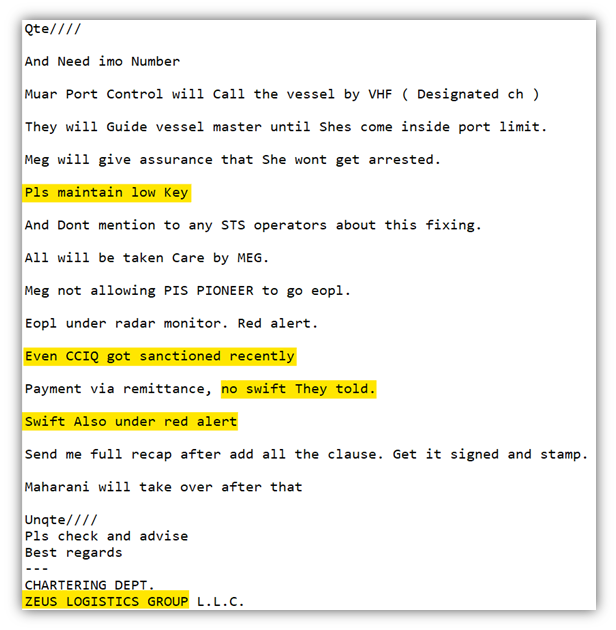
Zeus Logistics representetive instructs Chengtuo Group to refrain from risky, monitored transfers
This exchange illustrates how entities tied to Iran's financial mechanisms within the security apparatus continuously adapt their methods to circumvent sanctions, favoring lower-risk transfer methods with reduced oversight (domestic remittance as opposed to SWIFT transfers).
What can be concluded is that, on one hand, the host banks mentioned above have failed in their obligations to conduct enhanced due diligence (EDD), implement sanctions screening and monitor and report suspicious transactions to their regulators. On the other hand, the correspondent banks have failed in their mission to KYCC (Know Your Customer's Costumer) and, more broadly, to know their respondent bank – their business, reputation and compliance programs – to assess the risks and to monitor the transactions to some extent. The last example only reinforces how the shady transactions are calculated, planned, illegal financial mechanisms designed to avoid law enforcement.
The aforementioned banks, as well as Chinese and Emirati regulators, must take notice of the institutions exposed above. By providing services to entities associated with GDCP and Nosazan Kaveh, these banks are not only facilitating sanctions evasion and money laundering but are also undermining global efforts to curb illicit financial activities. It is imperative that they reassess their client base and comply with international sanctions and AML regulations to avoid severe consequences, including legal action and reputational damage.
WikIran exposes these banks accounts in an attempt to raise concerns about the financial mechanisms behind the IRGC oil exports, which ultimately finance its terrorist and criminal practices – in Iran and all around the globe.